5.25: CPC Exam: Respiratory System
Here you'll find a breakdown of the respiratory system and a look at the types of respiratory surgery codes available in the CPT manual.

Section 5.01
What is the CPC Exam?
Section 5.02
General Preparation and Test Strategies for the CPC Exam
Section 5.03
CPC Exam: Anesthesia
Section 5.04
CPC Exam: Radiology
Section 5.05
CPC Exam: Medicine
Section 5.06
CPC Exam: The Nervous System
Section 5.07
CPC Exam: The Endocrine System
Section 5.08
CPC Exam: The Digestive System
Section 5.09
CPC Exam: The Urinary System
Section 5.10
CPC Exam: The Musculoskeletal System
Section 5.11
CPC Exam: Evaluation and Management
Section 5.12
CPC Exam: Anatomy and Physiology
Section 5.13
CPC Exam: Mediastinum and Diaphragm
Section 5.14
CPC Exam: Practice Management
Section 5.15
CPC Exam: Male and Female Genital System
Section 5.16
CPC Exam: Hemic and Lymphatic System
Section 5.17
CPC Exam: Maternity and Delivery
Section 5.18
CPC Exam: Eye and Ocular Adnexa
Section 5.20
CPC Exam: HCPCS Level II
Section 5.21
CPC Exam: Coding Guidelines
Section 5.22
CPC Exam: Medical Terminology
Section 5.23
CPC Exam: Pathology and Laboratory
Section 5.24
CPC Exam: Integumentary
Section 5.25
CPC Exam: Respiratory System
Section 5.26
CPC Exam: Cardiovascular System
Section 5.27
CPC Exam: Where to Take an Exam
Section 5.28
The CPC Apprentice Program
Section 5.29
The CPB Exam







We're going to close out our review of the topics on the CPC exam with the respiratory system and the cardiovascular system. Both of these are found in what's sometimes referred to as the "30,000 series," along with the hemic and lymphatic system and mediastinum and diaphragm. (The musculoskeletal system, for instance, takes up all of the 20,000 series, featuring codes between 20000 and 29999).
We'll focus on the respiratory system here, and the cardiovascular system in Course 2-26.
You should expect to see around 10 questions on codes in the 30,000 series. Of those ten, only one or two will be on the respiratory system. Still, you can't be too prepared, so let's dive into the respiratory system now.
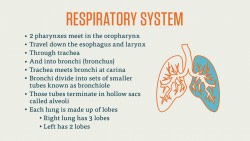
The respiratory system is, obviously, how we breathe. Air enters into our body through our nose or mouth. When it enters through out nose, it travels through the nasal cavity and into the nasopharynx. When it enters through the mouth, it travels into the oropharynx (think "oral" = oro).
The two pharynxes meet in the oropharynx, and air then travels down the esophagus and the larynx, through the trachea, and into the bronchi (singular: bronchus), which are tree-like sets of tubes that extend into each lung. The trachea meets the bronchi at a point called the carina. Each bronchus divides into a set of smaller tubes, known as the bronchiole. Those tubes terminate in hollow sacs called alveoli. Each lung is made up of lobes. The right lung has three lobes, while the left has two.
The procedure codes are laid out just like the structure of the respiratory system. Toward the front of the subsection you'll find codes for procedures on the nose, including the removal of foreign bodies, and reconstructive surgery like rhinoplasties. You'll also find procedures on the sinuses in this part of the respiratory subsection.
Following the nose and nasal passages, you'll find a procedures on the trachea and bronchi, including exploratory surgery (with endoscopy), excision, and repair (such as "carinal repair").
The final and largest area of the respiratory system subsection is that of the lungs and pleura. The pleura are a set of membranes that cover the lungs. The parietal pleura coats the lungs on the outside, and separates them from the chest cavity. The visceral pleura is situated between the parietal pleura and the lung itself.
Under lung and pleura you'll find codes for incision, excision, resection, removal, and exploration of the lung and pleura. You'll also find codes for video-assisted thoracic surgery (VATS) procedures. You'll also find codes for transplantation. These, like other transplantation or graft codes, have guidelines for coding where the donor lung came from. That is, is the lung coming from a cadaver or a live donor.