5.17: CPC Exam: Maternity and Delivery
In this course, we'll cover the maternity and delivery section of the CPC exam. You'll find an overview of the codes for maternity and delivery in the CPT manual, along with tips for what to expect on the test.

Section 5.01
What is the CPC Exam?
Section 5.02
General Preparation and Test Strategies for the CPC Exam
Section 5.03
CPC Exam: Anesthesia
Section 5.04
CPC Exam: Radiology
Section 5.05
CPC Exam: Medicine
Section 5.06
CPC Exam: The Nervous System
Section 5.07
CPC Exam: The Endocrine System
Section 5.08
CPC Exam: The Digestive System
Section 5.09
CPC Exam: The Urinary System
Section 5.10
CPC Exam: The Musculoskeletal System
Section 5.11
CPC Exam: Evaluation and Management
Section 5.12
CPC Exam: Anatomy and Physiology
Section 5.13
CPC Exam: Mediastinum and Diaphragm
Section 5.14
CPC Exam: Practice Management
Section 5.15
CPC Exam: Male and Female Genital System
Section 5.16
CPC Exam: Hemic and Lymphatic System
Section 5.17
CPC Exam: Maternity and Delivery
Section 5.18
CPC Exam: Eye and Ocular Adnexa
Section 5.20
CPC Exam: HCPCS Level II
Section 5.21
CPC Exam: Coding Guidelines
Section 5.22
CPC Exam: Medical Terminology
Section 5.23
CPC Exam: Pathology and Laboratory
Section 5.24
CPC Exam: Integumentary
Section 5.25
CPC Exam: Respiratory System
Section 5.26
CPC Exam: Cardiovascular System
Section 5.27
CPC Exam: Where to Take an Exam
Section 5.28
The CPC Apprentice Program
Section 5.29
The CPB Exam












You will definitely see some questions on maternity and delivery. Unfortunately, we can't give you an exact figure on that, as the AAPC keeps the breakdown of questions private. Still, there's a good chance you'll encounter at least one maternity and delivery question on the CPC exam.
Maternity and delivery codes are found 59000- 59899 numerical range, toward the rear of the Surgery section of the CPT manual. While relatively short, in terms of pages covered, these codes contain large amounts of information.
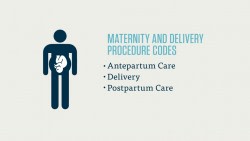
Unlike many other codes, most maternity and delivery codes bundle a number of procedures that occur over long stretches of time. For healthy, routine deliveries, maternity and delivery procedure codes include antepartum care, delivery, and postpartum care. That is, the monthly (up to 28 weeks gestation), bi-weekly (up to 36 weeks gestation), and weekly (up to delivery) visits are all included in the delivery codes. So too are the evaluations of the mother's blood pressure, amniotic fluid, and urinalysis.
Note however that procedures that fall outside the range of maternity care (say the mother gets a head cold) are not included in maternity and delivery codes, and must be listed separately.
Fetal ultrasounds are used in a number of procedures in the maternity and delivery section. One example: amniocentesis, the draining or sampling of the amniotic fluid via a hollow needle, uses an ultrasound to guide the surgeon and help avoid damaging the fetus. When an ultrasound is used in a maternity procedure, it's listed in the maternity and delivery subsection. If its used in a diagnostic capacity, it's found in the Radiology section.
Other antepartum services that are found in the maternity and delivery subsection include vaginal or cervical repairs and tests on the fetus.
The most important codes in this relatively short section are the delivery codes. There are four different types of delivery: vaginal, caesarean, and vaginal birth after a caesarean, which is abbreviated to VBAC. In a VBAC, there are two outcomes: successful and unsuccessful. To illustrate this, let's say a woman delivered her first child via caesarean section, but is going to deliver her second child vaginally. If the delivery is successful, we would code that as a successful VBAC, not as a vaginal delivery. Likewise, if the delivery was unsuccessful, and the doctor has to step in to perform a caesarean to complete the delivery, we would code that as an unsuccessful VBAC, not as a regular caesarean.
The maternity and delivery subsection is rounded out with a variety of abortion codes. These codes include procedures for treatment following an abortion (for example, if the abortion goes septic, or if it only partially successful), and there are also codes for induced abortions.
As you're studying for the CPC exam, be sure to keep an eye on the maternity and delivery section. You will most likely see at least one question on these codes, and it should be relatively obvious.