5.24: CPC Exam: Integumentary
Watch this video to review the integumentary system for the CPC exam. We've included a breakdown of integumentary codes, and a look at what to expect on the test.

Section 5.01
What is the CPC Exam?
Section 5.02
General Preparation and Test Strategies for the CPC Exam
Section 5.03
CPC Exam: Anesthesia
Section 5.04
CPC Exam: Radiology
Section 5.05
CPC Exam: Medicine
Section 5.06
CPC Exam: The Nervous System
Section 5.07
CPC Exam: The Endocrine System
Section 5.08
CPC Exam: The Digestive System
Section 5.09
CPC Exam: The Urinary System
Section 5.10
CPC Exam: The Musculoskeletal System
Section 5.11
CPC Exam: Evaluation and Management
Section 5.12
CPC Exam: Anatomy and Physiology
Section 5.13
CPC Exam: Mediastinum and Diaphragm
Section 5.14
CPC Exam: Practice Management
Section 5.15
CPC Exam: Male and Female Genital System
Section 5.16
CPC Exam: Hemic and Lymphatic System
Section 5.17
CPC Exam: Maternity and Delivery
Section 5.18
CPC Exam: Eye and Ocular Adnexa
Section 5.20
CPC Exam: HCPCS Level II
Section 5.21
CPC Exam: Coding Guidelines
Section 5.22
CPC Exam: Medical Terminology
Section 5.23
CPC Exam: Pathology and Laboratory
Section 5.24
CPC Exam: Integumentary
Section 5.25
CPC Exam: Respiratory System
Section 5.26
CPC Exam: Cardiovascular System
Section 5.27
CPC Exam: Where to Take an Exam
Section 5.28
The CPC Apprentice Program
Section 5.29
The CPB Exam


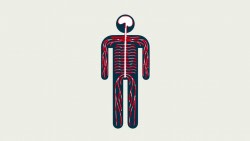




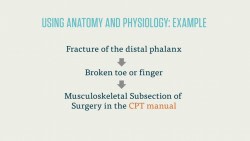
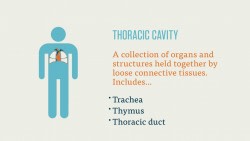


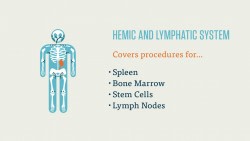








The integumentary system is, put simply, the skin. The skin is the largest organ in the human body. It protects, and allows for homeostasis, among a number of other functions.
The skin is made up of three main layers: the epidermis, the dermis, and the hypodermis. Each of these performs it's own set of specific functions. The dermis, for example, allows for the skin's flexibility, and also houses nerve endings and blood vessels.
You should expect approximately ten questions on the integumentary system on the CPC exam. Let's review the system itself and its dedicated CPT subsection now.
You'll find codes for procedures on the integumentary system in the 10021 – 19499 numerical range of the CPT manual. It's the first subsection of Surgery.
Recommended Online Programs
You'll find codes for incisions, wound debridement, skin tag removal, and the excision of benign and malignant lesions at the front of the integumentary subsection. Debridement and excision codes all include measurements: the depth of the tissue removed via debridement, for example, or the diameter of the lesion removed. Code according to these measurements. There are also specific codes for the number of lesions removed in a single procedure. Keep this in mind as your reading any question related to lesion removal.
Toward the middle you'll find codes for skin grafts, skin repair, and other tissue transfers. In this section, you'll need to know the different sources of grafts (autografts are grafts from the patient, allografts are grafts from a cadaver, and xenographs are grafts from animals or man-made sources). You'll also find a number of codes for different skin replacement surgeries.
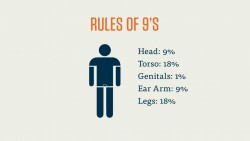
The next area of the integumentary section is burns. Here you'll need to know the "rules of 9s." The surface area of the human body is divided into multiples of 9: the legs are each 18%, as is the front and back of the torso. Each arm accounts for 9%, as does the head. The genitals are 1%. So a patient who has burns over the left leg and left arm has burns over 27% of their body.
At the end of the integumentary subsection, you'll find codes for the breasts. The breasts aren't technically part of the integumentary system, but according to the AMA, this is the best place for them. You'll find codes for mastectomies, breast repair and reconstruction, and the excision of cysts, tumors, and lesions.